Updated August 25, 2026. New York City apartment-building owners and property managers need to understand how intercom, entrance-door and door-release requirements apply to their properties. New York Multiple Dwelling Law § 50-a and New York City Department of Buildings rules establish requirements for certain Class A multiple dwellings, including two-way voice communication and the ability for an apartment occupant to release the main entrance locking mechanism.
The exact requirements can depend on the building’s residential classification, number of apartments and when the building was erected or converted to residential use. This guide explains the key rules, common compliance questions and practical steps owners and managers can use when evaluating an intercom system.
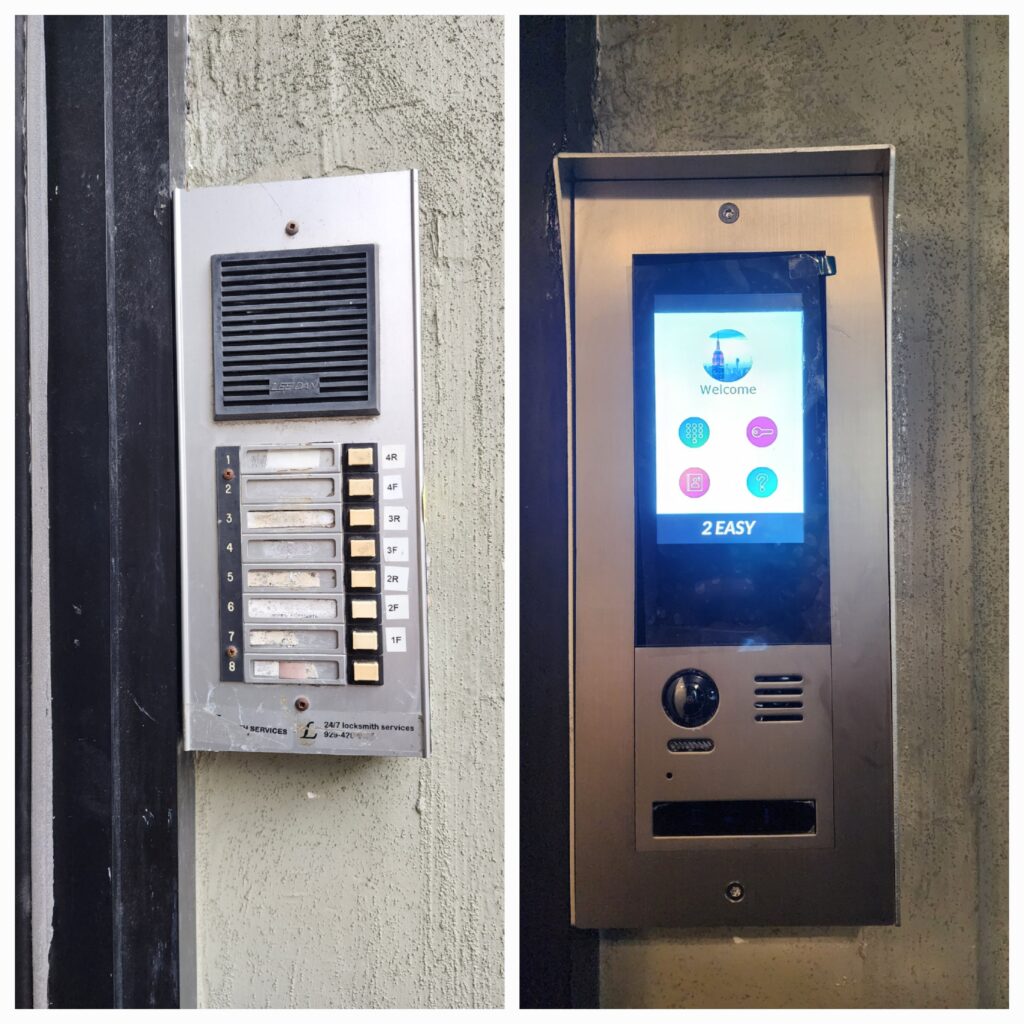
Photo by Unlimited Applications Security Company
What Does the NYC Intercom Law Require?
For a Class A multiple dwelling erected or converted after January 1, 1968 with eight or more apartments, New York Multiple Dwelling Law § 50-a requires an intercommunication system at the automatic self-locking entrance door that provides public access to the building’s main entrance hall or lobby.
The required system must support two core functions: voice communication between the occupant of each apartment and a person outside the required entrance door, and remote door release so the apartment occupant can release the entrance locking mechanism from the apartment.
Read the current text of New York Multiple Dwelling Law § 50-a.
Which NYC Apartment Buildings Need an Intercom?
Buildings Erected or Converted After January 1, 1968
A Class A multiple dwelling erected or converted after January 1, 1968 and containing eight or more apartments is specifically covered by the statutory intercommunication-system requirement.
Buildings Erected or Converted Before January 1, 1968
Older buildings are treated differently. For qualifying Class A multiple dwellings erected or converted before January 1, 1968, the statute includes a provision under which installation of the specified self-locking doors and intercommunication system is required when tenants occupying a majority of the apartments request or consent to the installation in writing.
Owners of older New York City apartment buildings should therefore avoid assuming that the same rule applies identically to every property. Building age, occupancy classification, apartment count and the property’s history should be reviewed when determining the applicable requirements.
What Must a NYC Apartment Intercom System Do?
A building intercom covered by these requirements is more than a simple entrance doorbell. The system should support communication between residents and visitors and work together with the entrance locking equipment.
Two-way voice communication: residents must be able to communicate with someone outside the required building entrance.
Door-release capability: the apartment occupant must be able to activate the mechanism that releases the applicable entrance-door lock.
Proper equipment location and access: applicable entrance and apartment equipment must be installed in accordance with the governing rules and remain accessible for its intended use.
Working entrance hardware: a functioning intercom does not correct a failed electric strike, relay, power supply, door closer or locking mechanism. The entire controlled-entry system should operate correctly.
New York City Department of Buildings rules also address entrance-door locks, intercommunication equipment and equipment location. See 1 RCNY § 42-01.
Does an Existing Intercom Have to Be Maintained?
Yes. Multiple Dwelling Law § 50-a addresses both installation and maintenance of required entrance doors, locks and intercommunication equipment. A system that was compliant when installed but no longer allows residents to hear visitors, speak to visitors or release the entrance door may require repair.
Common failures include apartment stations that do not ring, one-way or distorted audio, failed lobby call buttons, incorrect apartment call routing, defective transformers, wiring failures, faulty relays, electric strikes that do not release and entrance doors that fail to close or latch correctly.
Because multiple components work together, troubleshooting should cover the entire communication and door-release path rather than automatically replacing the lobby intercom panel.
Can a Telephone or Smartphone Intercom Comply With NYC Requirements?
Modern telephone-entry, Internet Protocol, cellular and mobile-app intercom systems may provide functionality suitable for New York City apartment buildings, but a system should not be assumed to satisfy legal requirements simply because it provides smartphone access.
The selected configuration should be reviewed against the requirements that apply to the particular property, including required voice communication, entrance-door operation and resident access.
Owners considering smart-access technology should also review New York City’s Tenant Data Privacy Law guidance, which can apply to certain multiple dwellings using mobile apps, electronic credentials, keyless systems and other smart-access technologies.
Intercom Problems Can Actually Be Door-Release Problems
Intercom compliance and entrance-door operation are closely connected. A resident may be able to speak with a visitor while still being unable to buzz the entrance door open because the actual failure is in the electric strike, relay, power supply, wiring or door alignment.
A useful troubleshooting sequence is: lobby intercom panel → apartment station or telephone connection → control equipment → relay → power supply → electric strike or locking hardware → entrance door.
NYC Intercom Compliance Checklist for Property Owners
1. Confirm the building’s occupancy classification.
2. Determine when the building was erected or converted to residential use.
3. Confirm the number of apartments.
4. Check whether the applicable entrance doors self-close and self-lock as required.
5. Verify that each required apartment can receive a visitor call and communicate clearly.
6. Verify that residents can activate the required entrance-door release.
7. Test the electric strike, relay, power supply, locking hardware and door alignment.
8. Review planned smart-access upgrades for any additional privacy or technology requirements.
Repair or Replace an Older NYC Intercom?
A malfunctioning intercom does not automatically require full replacement. Many older apartment-building systems remain serviceable when the wiring infrastructure is sound and compatible replacement components are available.
Repair may be appropriate when the problem involves a failed apartment station, button, speaker, microphone, transformer, relay, wiring connection or door-release component. Replacement or modernization may make more sense when equipment is obsolete, replacement parts are unavailable, wiring is severely deteriorated, multiple components repeatedly fail or the building needs capabilities the existing platform cannot support.
Professional NYC Intercom Installation and Repair
Unlimited Applications Security Company provides intercom repair, apartment buzzer repair, lobby-panel troubleshooting, telephone-entry service, video intercom installation, door-release repair and electric-strike troubleshooting for properties throughout New York City.
Service is available for apartment buildings, condominiums, cooperative buildings, mixed-use properties and other residential and commercial locations in Queens, Brooklyn, Manhattan, the Bronx and Staten Island.
For intercom service or troubleshooting, call (347) 433-6873 or visit the NYC intercom systems and repair service page.
Frequently Asked Questions About NYC Intercom Requirements
Does every NYC apartment building legally need an intercom?
No. The requirement depends on factors including the building classification, date of erection or residential conversion and number of apartments. Class A multiple dwellings erected or converted after January 1, 1968 with eight or more apartments are specifically covered by Multiple Dwelling Law § 50-a.
What about an apartment building built before 1968?
For qualifying pre-1968 Class A multiple dwellings, the statute includes a majority-tenant written request or consent provision. Owners should review the property’s specific circumstances rather than automatically applying the post-1968 rule.
Does a NYC building intercom need two-way communication?
For buildings subject to Multiple Dwelling Law § 50-a, the intercommunication system must provide voice communication between apartment occupants and a person outside the required entrance.
Does the tenant have to be able to buzz the front door open?
The applicable system must allow the apartment occupant to release the locking mechanism of the required entrance door from the apartment.
Is a doorbell alone enough?
A simple doorbell that only announces a visitor does not provide the complete voice-communication and remote-door-release functionality described in Multiple Dwelling Law § 50-a for covered buildings.
Can a smartphone intercom replace an old apartment intercom?
Potentially, but compliance depends on the complete design and the requirements applicable to the building. A smartphone or cloud-based system should not automatically be considered compliant without reviewing communication, door-release, resident-access and other applicable requirements.
Who should verify whether a particular building complies with NYC law?
Intercom contractors can inspect and service the equipment, but property-specific legal or code determinations should be confirmed with the appropriate New York City agency or a qualified New York attorney, architect, engineer or code professional.
Important: This article provides general educational information and is not legal advice. Building requirements can vary according to occupancy, building age, alterations, prior approvals and other property-specific conditions. Owners and managers should verify current requirements before making compliance decisions.