NYC Intercom Law: Apartment Building Requirements & Compliance

Updated August 25, 2026. New York City apartment-building owners and property managers need to understand how intercom, entrance-door and door-release requirements apply to their properties. New York Multiple Dwelling Law § 50-a and New York City Department of Buildings rules establish requirements for certain Class A multiple dwellings, including two-way voice communication and the ability for an apartment occupant to release the main entrance locking mechanism.

The exact requirements can depend on the building’s residential classification, number of apartments and when the building was erected or converted to residential use. This guide explains the key rules, common compliance questions and practical steps owners and managers can use when evaluating an intercom system.

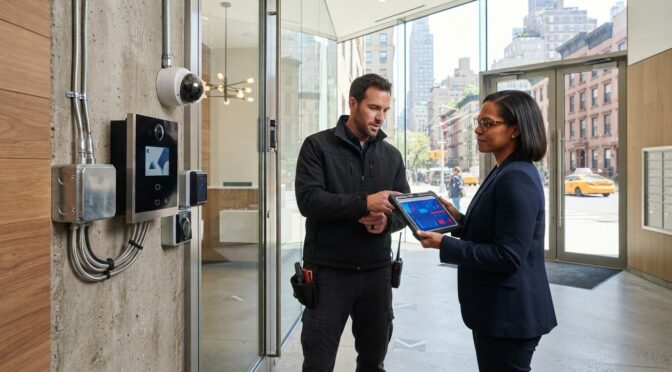
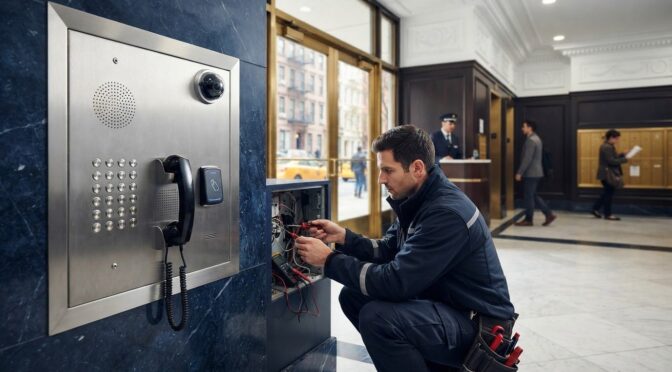
Intercom Call Panel

Photo by Unlimited Applications Security Company

What Does the NYC Intercom Law Require?

For a Class A multiple dwelling erected or converted after January 1, 1968 with eight or more apartments, New York Multiple Dwelling Law § 50-a requires an intercommunication system at the automatic self-locking entrance door that provides public access to the building’s main entrance hall or lobby.

The required system must support two core functions: voice communication between the occupant of each apartment and a person outside the required entrance door, and remote door release so the apartment occupant can release the entrance locking mechanism from the apartment.

Read the current text of New York Multiple Dwelling Law § 50-a.

Which NYC Apartment Buildings Need an Intercom?

Buildings Erected or Converted After January 1, 1968

A Class A multiple dwelling erected or converted after January 1, 1968 and containing eight or more apartments is specifically covered by the statutory intercommunication-system requirement.

Buildings Erected or Converted Before January 1, 1968

Older buildings are treated differently. For qualifying Class A multiple dwellings erected or converted before January 1, 1968, the statute includes a provision under which installation of the specified self-locking doors and intercommunication system is required when tenants occupying a majority of the apartments request or consent to the installation in writing.

Owners of older New York City apartment buildings should therefore avoid assuming that the same rule applies identically to every property. Building age, occupancy classification, apartment count and the property’s history should be reviewed when determining the applicable requirements.

What Must a NYC Apartment Intercom System Do?

A building intercom covered by these requirements is more than a simple entrance doorbell. The system should support communication between residents and visitors and work together with the entrance locking equipment.

Two-way voice communication: residents must be able to communicate with someone outside the required building entrance.

Door-release capability: the apartment occupant must be able to activate the mechanism that releases the applicable entrance-door lock.

Proper equipment location and access: applicable entrance and apartment equipment must be installed in accordance with the governing rules and remain accessible for its intended use.

Working entrance hardware: a functioning intercom does not correct a failed electric strike, relay, power supply, door closer or locking mechanism. The entire controlled-entry system should operate correctly.

New York City Department of Buildings rules also address entrance-door locks, intercommunication equipment and equipment location. See 1 RCNY § 42-01.

youtube placeholder image

Does an Existing Intercom Have to Be Maintained?

Yes. Multiple Dwelling Law § 50-a addresses both installation and maintenance of required entrance doors, locks and intercommunication equipment. A system that was compliant when installed but no longer allows residents to hear visitors, speak to visitors or release the entrance door may require repair.

Common failures include apartment stations that do not ring, one-way or distorted audio, failed lobby call buttons, incorrect apartment call routing, defective transformers, wiring failures, faulty relays, electric strikes that do not release and entrance doors that fail to close or latch correctly.

Because multiple components work together, troubleshooting should cover the entire communication and door-release path rather than automatically replacing the lobby intercom panel.

Can a Telephone or Smartphone Intercom Comply With NYC Requirements?

Modern telephone-entry, Internet Protocol, cellular and mobile-app intercom systems may provide functionality suitable for New York City apartment buildings, but a system should not be assumed to satisfy legal requirements simply because it provides smartphone access.

The selected configuration should be reviewed against the requirements that apply to the particular property, including required voice communication, entrance-door operation and resident access.

Owners considering smart-access technology should also review New York City’s Tenant Data Privacy Law guidance, which can apply to certain multiple dwellings using mobile apps, electronic credentials, keyless systems and other smart-access technologies.

Intercom Problems Can Actually Be Door-Release Problems

Intercom compliance and entrance-door operation are closely connected. A resident may be able to speak with a visitor while still being unable to buzz the entrance door open because the actual failure is in the electric strike, relay, power supply, wiring or door alignment.

A useful troubleshooting sequence is: lobby intercom panel → apartment station or telephone connection → control equipment → relay → power supply → electric strike or locking hardware → entrance door.

NYC Intercom Compliance Checklist for Property Owners

1. Confirm the building’s occupancy classification.

2. Determine when the building was erected or converted to residential use.

3. Confirm the number of apartments.

4. Check whether the applicable entrance doors self-close and self-lock as required.

5. Verify that each required apartment can receive a visitor call and communicate clearly.

6. Verify that residents can activate the required entrance-door release.

7. Test the electric strike, relay, power supply, locking hardware and door alignment.

8. Review planned smart-access upgrades for any additional privacy or technology requirements.

Repair or Replace an Older NYC Intercom?

A malfunctioning intercom does not automatically require full replacement. Many older apartment-building systems remain serviceable when the wiring infrastructure is sound and compatible replacement components are available.

Repair may be appropriate when the problem involves a failed apartment station, button, speaker, microphone, transformer, relay, wiring connection or door-release component. Replacement or modernization may make more sense when equipment is obsolete, replacement parts are unavailable, wiring is severely deteriorated, multiple components repeatedly fail or the building needs capabilities the existing platform cannot support.

Professional NYC Intercom Installation and Repair

Unlimited Applications Security Company provides intercom repair, apartment buzzer repair, lobby-panel troubleshooting, telephone-entry service, video intercom installation, door-release repair and electric-strike troubleshooting for properties throughout New York City.

Service is available for apartment buildings, condominiums, cooperative buildings, mixed-use properties and other residential and commercial locations in Queens, Brooklyn, Manhattan, the Bronx and Staten Island.

For intercom service or troubleshooting, call (347) 433-6873 or visit the NYC intercom systems and repair service page.

Frequently Asked Questions About NYC Intercom Requirements

Does every NYC apartment building legally need an intercom?

No. The requirement depends on factors including the building classification, date of erection or residential conversion and number of apartments. Class A multiple dwellings erected or converted after January 1, 1968 with eight or more apartments are specifically covered by Multiple Dwelling Law § 50-a.

What about an apartment building built before 1968?

For qualifying pre-1968 Class A multiple dwellings, the statute includes a majority-tenant written request or consent provision. Owners should review the property’s specific circumstances rather than automatically applying the post-1968 rule.

Does a NYC building intercom need two-way communication?

For buildings subject to Multiple Dwelling Law § 50-a, the intercommunication system must provide voice communication between apartment occupants and a person outside the required entrance.

Does the tenant have to be able to buzz the front door open?

The applicable system must allow the apartment occupant to release the locking mechanism of the required entrance door from the apartment.

Is a doorbell alone enough?

A simple doorbell that only announces a visitor does not provide the complete voice-communication and remote-door-release functionality described in Multiple Dwelling Law § 50-a for covered buildings.

Can a smartphone intercom replace an old apartment intercom?

Potentially, but compliance depends on the complete design and the requirements applicable to the building. A smartphone or cloud-based system should not automatically be considered compliant without reviewing communication, door-release, resident-access and other applicable requirements.

Who should verify whether a particular building complies with NYC law?

Intercom contractors can inspect and service the equipment, but property-specific legal or code determinations should be confirmed with the appropriate New York City agency or a qualified New York attorney, architect, engineer or code professional.

Important: This article provides general educational information and is not legal advice. Building requirements can vary according to occupancy, building age, alterations, prior approvals and other property-specific conditions. Owners and managers should verify current requirements before making compliance decisions.

ADA Door Operator Installation in Long Island, NY

ADA door operator installation in Long Island, NY can make an entrance easier to use while integrating the door with an electric strike, wireless push-to-open buttons, and an existing access-control or door-entry system. Unlimited Applications Security Company installs and integrates automatic door operators for residential, commercial, office, institutional, and managed properties throughout the New York City metropolitan area and Long Island.

Quick answer: An ADA-oriented automatic door system typically works by receiving an activation signal from a wall-mounted or wireless push button. The electric strike releases the locked door, the automatic operator opens it, holds it open for a programmed period, and then allows it to close in a controlled manner. The operator, strike, lock hardware, activation devices, wiring, door condition, and programming must all work together as one system.

Watch: ADA Door Operator and Electric Strike Integration

This short video shows an automatic door operator integrated with an electric door strike and wireless push buttons in Long Island, NY.

youtube placeholder image

What Is an ADA Automatic Door Operator?

An automatic door operator is a powered device mounted at the door that opens the door after it receives an activation signal. In many accessibility-focused applications, the operator is paired with large push-to-open buttons or touchless activation devices so a person does not have to pull or push a heavy door manually.

The operator is only one part of the entrance. A complete installation may also include an electric strike, access-control relay, wireless receiver, push plates, power supply, door-position hardware, and properly adjusted closing hardware. The exact configuration depends on the door, frame, lockset, traffic pattern, and how the entrance is supposed to remain secured.

It is important to distinguish between an ADA-oriented automatic door solution and a blanket claim that one device automatically makes an entrance compliant. Accessibility depends on the complete doorway, hardware, clearances, operating force, controls, mounting locations, timing, and other site-specific conditions. Property owners and managers should evaluate the complete entrance against applicable accessibility and building requirements.

How Does an Automatic Electric Door Strike Work?

An electric door strike is installed in the door frame and works with the latch on the door. When the strike receives the correct electrical signal, it temporarily releases the latch so the door can open without someone mechanically turning the lock from the secured side.

When an electric strike is integrated with an automatic door operator, the sequence can work like this:

  1. The user activates the door. A wireless push button, wall plate, access-control credential, intercom door-release command, or other approved input sends a request to open.
  2. The electric strike releases. The locking hardware unlocks for the programmed interval.
  3. The door operator activates. After the strike has released, the operator powers the door open.
  4. The door remains open. The hold-open time is adjusted for the application and expected users.
  5. The door closes and relocks. The operator returns the door to the closed position and the electric strike resumes its secured state.

Correct sequencing matters. If the operator tries to pull the door open before the electric strike has fully released, the door can bind, fail to open, or place unnecessary stress on the operator and locking hardware. Proper integration coordinates the lock release and door movement rather than treating them as separate devices.

Wireless Push Buttons for Automatic Doors

Wireless push-to-open buttons are useful when running new control wiring would be difficult, disruptive, or unattractive. A wireless transmitter in the activation button communicates with a receiver connected to the automatic operator or control interface. Depending on the system design, that receiver can initiate the full unlock-and-open sequence.

Common locations include building entrances, vestibules, office doors, medical facilities, community spaces, retail entrances, and residential common areas. Push buttons should be positioned where users can approach and operate them safely without standing directly in the path of the moving door.

Why Integrate the Door Operator With the Electric Strike?

A door can be accessible and still need to remain secure. Integrating the automatic operator with the electric strike helps preserve both goals: authorized or intended users can activate the entrance more easily, while the door returns to a locked condition after the opening cycle is complete.

This type of integration can be especially useful where a property already has an intercom, key fob reader, keypad, card reader, telephone entry system, or other access-control equipment. In many cases, the new operator can be designed to work with the existing entry workflow instead of forcing the property to replace every door-control component.

Typical ADA Door Operator Integration Components

  • Low-energy automatic door operator
  • Wireless or hard-wired push-to-open buttons
  • Electric strike or compatible electrified locking hardware
  • Wireless receiver and interface relay
  • Power supply and control wiring
  • Access-control, intercom, keypad, card-reader, or door-release interface when required
  • Door-position and safety-related hardware when required by the selected system and application
  • Programming for unlock delay, opening speed, hold-open time, and closing sequence

When Is an Automatic Door Operator a Good Upgrade?

An automatic operator may be a practical upgrade when a door is difficult to use manually, when a building needs a more accessible entrance, when staff regularly assist visitors at the door, or when an existing access-control system needs a hands-free or push-button opening option.

It can also be useful during an entry-system modernization project. For example, a property may already have an electric strike that works from an intercom but wants to add an automatic opening cycle. In that situation, the existing door-release function can sometimes be incorporated into the new operator sequence after the lock, door, frame, power, and control logic are evaluated.

Common Problems We Find During Door Operator Integration

  • The electric strike releases, but the automatic operator activates too early.
  • The door opens automatically but does not relock consistently.
  • The push button activates the operator but not the locking hardware.
  • The door rubs the frame, drags, or does not latch correctly after closing.
  • The existing power supply cannot properly support the added equipment.
  • Wireless activation is unreliable because of receiver placement, battery condition, or signal interference.
  • The door closer or mechanical hardware fights the powered operator.
  • Existing access-control programming does not match the required door-opening sequence.

These issues are why troubleshooting the complete opening—not just the operator—is important. The lock, hinges, frame, closer, operator, controls, wiring, and access system all affect the final result.

ADA Door Operator Installation for Long Island Properties

Long Island has a wide mix of building types, from professional offices and retail locations to houses of worship, medical spaces, multifamily properties, and managed residential buildings. Each entrance can present a different combination of door construction, locking hardware, access-control equipment, and accessibility needs.

Unlimited Applications Security Company provides electronic door-entry and security-system services throughout Long Island and the New York City metropolitan area. Before recommending an operator configuration, the door and existing entry hardware should be evaluated so the new equipment can be integrated cleanly instead of simply added on top of unresolved mechanical or electrical problems.

For more information about the company’s service coverage, visit the New York City and Long Island service areas page.

Automatic Door Operator Installation Process

  1. Door and hardware evaluation: Check the door, frame, hinges, latch, strike, closer, and existing control equipment.
  2. System design: Determine how the operator, lock release, push buttons, access control, and power will interact.
  3. Operator and activation-device installation: Mount and connect the automatic operator, receiver, push buttons, and required interfaces.
  4. Electric strike integration: Coordinate the door-release timing with the automatic opening command.
  5. Programming and adjustment: Set the opening sequence, hold-open period, closing behavior, and other system parameters.
  6. Functional testing: Verify repeated unlock, open, hold, close, and relock cycles from each approved activation method.

Can an Existing Electric Strike Be Used?

Sometimes. An existing electric strike may be reusable when it is mechanically compatible with the door, operates reliably, has the correct electrical characteristics for the control design, and can be sequenced with the automatic operator. If the strike is worn, misaligned, underpowered, or unsuitable for the planned control logic, replacement may be the better option.

Can the Automatic Operator Work With an Existing Access-Control System?

Often, yes. Automatic operators can frequently be integrated with existing keypads, card readers, key fobs, intercom door release, telephone entry, and other access-control equipment through appropriate relays and control interfaces. The design should ensure that the door unlocks before the operator begins the opening cycle.

Frequently Asked Questions About ADA Door Operators

What happens when someone presses the wireless push button?

The button sends an activation signal to the system. In an integrated installation, the electric strike releases first, the automatic operator opens the door, the door remains open for the programmed period, and then it closes and returns to its secured state.

Does an automatic door operator automatically make a door ADA compliant?

No single device guarantees compliance by itself. The complete doorway—including clearances, hardware, controls, mounting locations, operating characteristics, and surrounding approach—must be evaluated for the applicable accessibility requirements.

Can two wireless push buttons operate the same door?

Yes, many systems can use multiple activation devices, such as one button on each side of the doorway. The exact arrangement depends on the operator, receiver, security requirements, and desired entry and exit behavior.

Can an electric strike and door operator work with an intercom?

Yes. An intercom door-release command can often be integrated with the strike and operator so an authorized person can unlock and automatically open the entrance. The control sequence must be designed so the door is released before the operator attempts to open it.

What if the door opens but does not latch when it closes?

The issue may involve door alignment, hinges, closer adjustment, strike alignment, operator settings, weather conditions, or other mechanical hardware. The complete door should be inspected rather than increasing operator force to compensate for a mechanical problem.

Do wireless push buttons require new wiring?

The activation button itself may not require a new control cable back to the operator, but the receiver and operator still require proper power and control connections. Battery maintenance and reliable signal range should also be considered.

Can an automatic operator be added to an existing commercial door?

In many cases, yes, but the door, frame, locking hardware, closer, available mounting space, power, and control requirements must be evaluated before the operator is selected.

Do you install ADA door operators on Long Island?

Unlimited Applications Security Company provides electronic security and door-entry services throughout Long Island and the New York City metropolitan area. Site-specific availability and the appropriate equipment configuration can be confirmed after reviewing the entrance and project requirements.

Request an ADA Door Operator Evaluation

If you need an automatic door operator, electric strike integration, wireless push-to-open buttons, or access-control door integration in Long Island, NY, contact Unlimited Applications Security Company to discuss the entrance, existing hardware, and desired opening sequence.

Call (347) 433-6873 or use the contact page to request information about your project.

Accessibility and building requirements can vary by doorway, occupancy, jurisdiction, and project scope. Equipment should be selected and installed as part of a complete entrance evaluation.

Intercom Repair in Brooklyn, NY: Common Problems, Repair Options & When to Call a Technician

A malfunctioning intercom can quickly become more than an inconvenience. In a Brooklyn apartment building, brownstone, condominium, office or commercial property, the intercom is often directly connected to visitor communication and controlled entry.

When residents cannot hear visitors, a lobby panel will not call an apartment, video disappears or the entrance door will not release, the problem may involve the intercom station, wiring, power supply, door strike or another part of the door-entry system.

Unlimited Applications Security Company provides professional intercom repair services throughout Brooklyn, New York, helping property owners, building managers, businesses and residents troubleshoot existing systems and determine whether a component can be repaired, replaced or upgraded.

For Brooklyn intercom service, call (347) 433-6873.

What Does an Intercom Repair Technician Check?

Intercom problems are not always caused by the device that appears to have failed. For example, pressing an apartment’s door-release button without unlocking the entrance does not automatically mean the apartment station is defective. The problem could involve the electric strike, relay, transformer, power supply, wiring or connections between the intercom and entrance door.

Professional troubleshooting typically follows the complete signal path instead of replacing parts unnecessarily. A Brooklyn intercom repair technician may evaluate the entrance panel, apartment stations, audio or video connections, power supplies, transformers, low-voltage wiring, relays, electric door strikes and associated door-entry equipment.

Common Intercom Problems in Brooklyn Buildings

  • Apartment buzzer does not ring
  • Visitor cannot hear the resident
  • Resident cannot hear the visitor
  • Static, buzzing or distorted audio
  • Video intercom screen has no picture
  • Door-release button does not unlock the entrance
  • Electric door strike buzzes but the door remains locked
  • One apartment station stops working
  • Multiple apartments lose intercom service
  • Lobby entrance panel does not respond
  • Call buttons work intermittently
  • System repeatedly loses power
  • Existing intercom wiring has been damaged

Why Is My Brooklyn Apartment Intercom Not Working?

There is no single cause. A system that has completely stopped operating could have a power-related problem. A single apartment that cannot receive calls may have a local station or wiring problem. Building-wide audio problems may originate at a central amplifier, entrance panel or common wiring connection.

In older Brooklyn buildings, existing low-voltage wiring can also become an important part of the troubleshooting process. That is why repairing an intercom should begin by identifying whether the failure is isolated to one apartment, one function or the entire building.

Door Buzzer Repair in Brooklyn, NY

A door buzzer system allows occupants to identify or communicate with a visitor and remotely release an entrance door. When the buzzer stops working, residents may be unable to admit guests, delivery personnel or service providers without physically going to the entrance.

Depending on the system, the problem can originate with an apartment station, entrance panel, transformer, wiring, relay or electric door strike.

Door Release and Electric Strike Problems

If the intercom works but the entrance door does not unlock, the intercom itself may not be the source of the problem. The electric door strike is the component that releases the locked entrance after receiving the appropriate signal.

A technician can determine whether the door-release command is reaching the strike and whether the associated power and switching equipment are functioning correctly.

Audio Intercom Repair

Traditional audio intercom systems remain common throughout Brooklyn. Typical audio problems include low volume, static, one-way communication, buzzing, dead speakers, defective microphones and apartment stations that no longer receive calls.

Video Intercom Repair in Brooklyn

Video intercoms add visual identification to traditional visitor communication. Problems can include a blank indoor monitor, poor entrance-camera image, intermittent video, a non-responsive touchscreen or communication failures between the entrance station and individual apartments.

Should You Repair or Replace an Older Intercom?

A broken intercom does not automatically require complete replacement. Repair may make sense when the system remains serviceable and the failure can be isolated to a specific component, connection, power source or section of wiring.

Replacement or upgrading may deserve consideration when the existing system experiences repeated failures, replacement components are no longer practical to obtain, extensive wiring problems exist, multiple stations are deteriorating or the building wants newer video and remote-entry capabilities.

Intercom Repair for Brooklyn Apartment Buildings

Multi-family buildings create different troubleshooting challenges than single-family properties. A failure affecting one apartment is very different from a failure affecting every apartment in the building.

For example, if only one tenant cannot hear the entrance panel, troubleshooting can initially focus on that apartment station and its connections. If every apartment loses communication simultaneously, the likely fault may be located in common equipment.

Brooklyn Properties We Serve

Intercom and door-entry systems are used throughout many types of Brooklyn properties, including brownstones, walk-up apartment buildings, condominiums, cooperative buildings, multi-family properties, residential developments, offices, retail businesses, mixed-use buildings and other commercial facilities.

Intercom Service Throughout Brooklyn

Unlimited Applications Security Company provides intercom services throughout Brooklyn communities including Park Slope, Williamsburg, Bushwick, Bedford-Stuyvesant, Crown Heights, Brooklyn Heights, Downtown Brooklyn, DUMBO, Bay Ridge, Borough Park, Flatbush, Canarsie, Red Hook, Sunset Park, Bensonhurst, Greenpoint, Prospect Heights, East Flatbush, Carroll Gardens and Cobble Hill.

Learn more about Brooklyn intercom installation and repair services or visit our Park Slope intercom services page.

What Information Should You Provide When Requesting Intercom Repair?

Tell the service company what type of property you have, whether the problem affects one apartment or the entire building, whether audio still works, whether video still works, whether the entrance door releases, whether the problem is constant or intermittent and, if known, the manufacturer of the installed equipment.

How Much Does Intercom Repair Cost in Brooklyn?

The cost of intercom repair can vary because the visible symptom does not always identify the failed component. Important factors can include the type of system, number of apartments affected, accessibility of wiring, equipment condition, replacement parts required, door-release hardware and whether the problem involves a localized component or building-wide infrastructure.

Frequently Asked Questions About Brooklyn Intercom Repair

Who repairs apartment intercom systems in Brooklyn, NY?

Unlimited Applications Security Company provides intercom repair and troubleshooting for apartment buildings, brownstones, residential properties and commercial locations throughout Brooklyn. Call (347) 433-6873 to discuss the problem with your existing system.

Can an old Brooklyn apartment intercom be repaired?

Often, yes. Repair feasibility depends on the condition of the equipment, availability of compatible components, wiring condition and the specific failure.

Why does my intercom work but the door will not unlock?

The problem may involve the electric door strike, relay, wiring, power supply or another part of the door-release circuit rather than the communication portion of the intercom.

Can one broken apartment intercom be repaired without replacing the entire building system?

In many situations, a problem affecting only one apartment can be isolated and repaired without replacing every apartment station. The actual solution depends on the system and the cause of the failure.

Do you repair video intercom systems in Brooklyn?

Unlimited Applications Security Company provides troubleshooting for audio and video intercom and door-entry systems. The repair approach depends on the equipment, system architecture and problem being experienced.

Do you service intercom systems throughout Brooklyn?

Yes. Service is available throughout Brooklyn, including Park Slope, Williamsburg, Bushwick, Bedford-Stuyvesant, Crown Heights, Flatbush, Bay Ridge, Downtown Brooklyn, DUMBO, Canarsie and surrounding neighborhoods.

Schedule Intercom Repair in Brooklyn, NY

If your apartment buzzer does not ring, your intercom has no sound or video, visitors cannot communicate with residents or your entrance door will not release properly, professional troubleshooting can help determine exactly where the failure is occurring.

Unlimited Applications Security Company provides professional intercom repair and door-entry system services for Brooklyn residential and commercial properties.

Call (347) 433-6873 to request intercom service in Brooklyn, New York.

Learn more about Intercom Repair & Installation in Brooklyn

Security Camera Systems: Types, Benefits, and What NYC Property Owners Need to Know Before Buying

Whether you own a two-family home in Queens, manage a multi-unit building in Brooklyn, or run a retail store in the Bronx — a professionally installed security camera system is one of the smartest investments you can make. But with dozens of camera types, brands, and technologies on the market, knowing where to start can feel overwhelming. This guide breaks it all down.


THE MAIN TYPES OF SECURITY CAMERAS

Not all cameras are built for the same purpose. Here are the most common types installed in NYC residential and commercial properties — and what each one is best suited for.

Bullet cameras
Long, cylindrical shape. Ideal for monitoring long driveways, parking areas, and building exteriors. Highly visible — strong deterrent effect.

Dome cameras
Ceiling-mounted, compact design. Common in hallways, lobbies, and retail interiors. Vandal-resistant models available for high-risk locations.

PTZ cameras
Pan-tilt-zoom cameras that can be remotely controlled to track movement. Best for large outdoor areas, parking lots, and commercial properties.

Covert cameras
Hidden or disguised cameras for discreet monitoring. Used in retail loss prevention and sensitive interior locations.

Active deterrent cameras
Equipped with built-in spotlights and audio alarms that trigger on motion detection. Stops incidents before they escalate — not just records them.

Doorbell / entry cameras
Monitor building entrances, package deliveries, and visitor activity. Often integrated with intercom and access control systems.


ANALOG CCTV VS. IP CAMERA SYSTEMS

Analog / HD-TVI systems
Advantages: Lower upfront cost, works with existing coaxial wiring, simple setup and maintenance, reliable for basic coverage.
Limitations: Lower resolution than IP, limited remote access features, harder to scale or expand, no built-in analytics.

IP / network camera systems
Advantages: High-definition video (4K+ available), remote viewing from any device, AI-powered analytics and alerts, easy to add cameras as needed.
Limitations: Higher upfront installation cost, requires network infrastructure, more complex to configure, dependent on internet reliability.

UA Security tip: For most NYC multi-family homes and small businesses, a hybrid HD-TVI system hits the sweet spot — the image quality of IP cameras using your building’s existing coaxial wiring, at a fraction of the cost of a full IP network overhaul.


REAL BENEFITS BEYOND DETERRENCE

Crime deterrence: Studies consistently show that visible cameras reduce break-ins, vandalism, and package theft — particularly in multi-unit residential buildings and retail corridors.

Insurance liability protection: Footage from an incident can be the difference between winning and losing a slip-and-fall or property damage claim. Many NYC insurers offer premium discounts for documented camera coverage.

Remote monitoring: Modern IP systems let landlords, property managers, and business owners monitor their property in real time from any smartphone — anywhere in the world.

Tenant and employee confidence: A well-monitored building signals professionalism and accountability, which improves tenant retention and reduces turnover costs.

Evidence for police and legal action: NYPD routinely requests footage from building cameras to investigate incidents. Clear, timestamped HD footage dramatically increases the likelihood of arrest and prosecution.

Property value: A professionally installed camera system is an asset that transfers with the property — and is increasingly expected by buyers and commercial tenants in NYC.


WHAT TO LOOK FOR BEFORE YOU BUY

Resolution: For facial identification and license plate capture, you need a minimum of 2MP (1080p). For large outdoor areas, 4MP–8MP cameras are recommended.

Night vision capability: Look for infrared (IR) or full-color night vision. Active deterrent cameras with built-in white-light LEDs provide color footage at night and scare off intruders simultaneously.

Weather resistance (IP rating): NYC outdoor cameras need a minimum IP66 rating to handle rain, snow, humidity, and temperature swings. IP67 and IP68 rated cameras are ideal for exposed locations.

Storage and recording: Decide between local DVR/NVR recording, cloud storage, or a hybrid of both. For most NYC buildings, a local NVR with 30+ days of storage is the standard recommendation.

Coverage zones: A licensed installer will conduct a site assessment to identify blind spots, entry points, and coverage overlaps — critical for both security and insurance documentation purposes.

Licensed installation: In New York State, security system installation requires a licensed contractor. Always verify credentials — an unlicensed install can void your insurance coverage and create legal liability.


FREQUENTLY ASKED QUESTIONS

Q: How many cameras does my NYC building need?
A: It depends on the size and layout of your property. As a general rule, multi-family buildings in NYC should cover all entry and exit points, stairwells, hallways, and the building perimeter. A licensed security installer will conduct a free site assessment and recommend a camera count based on your specific property and risk profile.

Q: Do I need a permit to install security cameras in New York City?
A: For most residential and commercial camera installations, a building permit is not required. However, any installation that involves structural modifications or integration with a building’s electrical system may require permits. Your installer should advise you on compliance requirements for your specific project.

Q: What’s the difference between DVR and NVR systems?
A: A DVR (Digital Video Recorder) works with analog cameras over coaxial cable. An NVR (Network Video Recorder) works with IP cameras over a network connection, offering higher resolution and more flexibility. The right choice depends on your existing wiring and the type of cameras you install.

Q: Can I view my security cameras remotely from my phone?
A: Yes. Modern IP camera systems and many HD-TVI systems allow real-time remote viewing through a smartphone app. UA Security configures remote access during installation and ensures your system is secured with encrypted connections to prevent unauthorized access.

Q: How long does security camera installation take?
A: A typical residential installation of 4–8 cameras takes 4–8 hours. Larger commercial installations with 16+ cameras may take one to two days. UA Security provides a detailed installation timeline before work begins so there are no surprises.

Q: What security camera brands do you service and install?
A: UA Security installs and services all major brands including Hikvision, Dahua, Axis, Hanwha, Bosch, Uniview, and Lorex. We recommend systems based on your budget, property type, and coverage requirements — not based on brand preference alone.

Q: Do you repair existing security camera systems?
A: Yes. We repair cameras that are offline, showing blurry or no footage, have damaged wiring, or have DVR/NVR issues. We service all major brands and can often repair an existing system for a fraction of the cost of a full replacement.


Ready to protect your property with a professional camera system?

UA Security serves all five NYC boroughs — Queens, Brooklyn, the Bronx, Manhattan, and Staten Island. Licensed, experienced, and available 7 days a week. Call us for a free on-site assessment and quote.

Call (347) 433-6873
Visit https://www.uasecurity.com/security-camera-systems.htm

SecurityCameras #CCTVInstallation #NYCSecuritySystems #IPCameras #DVRRepair #NVRSystems #QueensSecurityCameras #BrooklynCCTV #UASecurityNYC #PropertySecurity#UnlimitedApplicationsSecurityCompanyNYC

NYC Video Intercom Installation: The Complete Guide for Building Owners

Why NYC Building Owners Are Upgrading to Video Intercom Systems

A standard audio-only buzzer system no longer meets the expectations of modern tenants — or the security demands of New York City building owners. NYC video intercom installation is one of the fastest-growing upgrade requests we receive from landlords, property managers, and co-op boards across all five boroughs.

With video intercom, tenants see and speak with visitors before granting access. It eliminates tailgating, package theft at the vestibule, and unauthorized entry — all without requiring a doorman.

Types of Video Intercom Systems We Install in NYC

1. Wired Video Intercom Systems

Traditional wired systems use dedicated cabling between the lobby panel and individual apartment stations. They offer the most reliable performance and are ideal for buildings where new cabling can be run cleanly. Most compatible with older NYC buildings that already have structured wiring.

2. IP / Network-Based Video Intercoms

IP video intercoms connect through the building’s existing data network or a dedicated LAN. They support remote access from smartphones, video recording, and integration with access control systems. Ideal for modern buildings or gut-renovated properties.

3. Smartphone-Compatible Video Intercoms (Mobile App Systems)

These systems allow tenants to receive visitor calls and open the door directly from their iPhone or Android phone — even when they’re not home. Perfect for NYC buildings where tenants work long hours and value remote access. Compatible with most existing wiring in pre-war and post-war buildings.

Frequently Asked Questions: NYC Video Intercom Installation

How much does video intercom installation cost in NYC?

NYC video intercom installation costs vary widely depending on building size, system type, and existing wiring. A single-family townhouse or small 4-unit building can expect to pay $800–$2,500. Larger multi-unit buildings with new wiring runs typically range from $3,000–$12,000+. We offer free on-site estimates for all projects.

Can a video intercom be installed in an older NYC building without rewiring?

In many cases, yes. Modern 2-wire and IP-over-coax systems are designed to work with older wiring. Our technicians assess your existing infrastructure during the free estimate and recommend the most cost-effective system that works with what you have.

How long does NYC video intercom installation take?

A typical installation in a small-to-medium building (up to 20 units) can be completed in one day. Larger buildings or those requiring full rewiring may take 2–3 days.

What brands do you install for video intercom in NYC?

We install Aiphone, 2N, Comelit, BPT, Doorbird, Siedle, and Akuvox, among others. We recommend systems based on your building’s specific needs, budget, and infrastructure.

Video Intercom Features That NYC Buildings Love

  • HD color camera with night vision — see visitors clearly day or night
  • Smartphone app door release — open the door remotely from anywhere
  • Visitor call logging — know who rang when
  • Multi-tenant support — works for buildings with dozens of units
  • Package delivery mode — couriers can leave deliveries without tenant interaction
Ready to Upgrade? Get a Free NYC Video Intercom Installation Quote. Call or text: (347) 433-6873 https://www.uasecurity.com/

We install video intercom systems across Manhattan, Brooklyn, Queens, the Bronx, and Staten Island. Call (347) 433-6873 to schedule your free on-site assessment.

Door Release Repair for Apartment Buildings: Why It Fails and How to Fix It

When the Door Won’t Unlock — Door Release Repair for NYC Apartment Buildings

Your intercom works. Tenants can hear the visitor. The buzzer rings. But the door won’t open. This is one of the most frustrating failures in an apartment building entry system — and it almost always points to a problem with the door release mechanism.

Door release repair for apartment buildings is a specialized service that goes beyond basic intercom troubleshooting. The electric strike, magnetic lock, or door release relay are separate components from the intercom itself — and each can fail independently.

Electric Door Strike

How Electric Door Release Systems Work

When a tenant presses the door release button on their intercom station, a signal is sent to the door entry panel, which then energizes a relay. That relay triggers an electric strike or magnetic lock — mechanically releasing the door latch and allowing the visitor to enter.

Any failure in this chain — from the intercom station signal to the wiring to the relay to the strike — will result in a door that doesn’t open, even when the intercom itself appears to be working.

Common Door Release Failures in NYC Apartment Buildings

  • Burned-out electric strike — the most common failure; the strike solenoid burns out from repeated use
  • Failed relay board in the main intercom panel — the relay that triggers the strike stops responding
  • Broken wiring between the panel and the strike — especially in older buildings
  • Incorrect voltage to the strike — the wrong voltage causes the strike to work intermittently or not at all
  • Mechanical door alignment issues — the door frame shifts and the strike can’t release the latch
  • Magnetic lock power supply failures — MLK-style mag locks lose holding force when the power supply fails

Frequently Asked Questions: Door Release Repair

Why does my apartment building door buzzer work but the door won’t open?

If tenants can hear visitors through the intercom but the door doesn’t release, the problem is almost certainly in the door release hardware — not the intercom itself. The most common causes are a burned-out electric strike, a failed relay in the main panel, or broken wiring between the panel and the strike.

How long does door release repair take?

Most door release repairs are completed within 1–3 hours. If the electric strike needs to be replaced, our technicians carry common replacement strikes for standard door preparations. If a custom-fit strike is needed, it may require a return visit.

Is door release repair covered by a warranty?

Yes. All labor performed by our technicians carries a 90-day warranty. Hardware and parts carry the manufacturer’s warranty, which typically ranges from 1–3 years.

Can you repair both magnetic locks and electric strikes?

Yes. We service all types of door release hardware including electric strikes (fail-secure and fail-safe), electromagnetic locks (maglocks), electric deadbolts, and electric latch retraction devices.

Door Not Opening? Get Door Release Repair Today. Call or text: (347) 433-6873 https://www.uasecurity.com/

Unlimited Applications Security provides door release repair for apartment buildings across all five NYC boroughs. Call (347) 433-6873 for same-day diagnostics and repair.

Security Camera Installation NYC: What Property Owners Need to Know Before They Buy

Why Professional Security Camera Installation in NYC Is Worth Every Dollar


Walk into any hardware store and you’ll find a shelf full of security cameras. So why hire a professional for security camera installation in NYC? Because installation is where most DIY systems fail — poor cable routing, wrong camera placement, no night vision coverage, inadequate storage, and cameras that don’t actually cover what they need to.
For NYC apartment buildings, commercial properties, storefronts, and residential homes, professional security camera installation means your system actually works when you need it.


Types of Security Camera Systems We Install in NYC


Analog HD / CCTV Systems
Traditional coax-based camera systems with HD resolution (1080p to 4K). Cost-effective, reliable, and ideal for buildings with existing coax cabling. DVR-based recording with local and remote storage options.
IP / Network Camera Systems
Modern IP cameras connect over ethernet (Cat5e/Cat6) and offer superior resolution, analytics, and integration with access control and intercoms. NVR-based recording with cloud backup capability. Best choice for new installations.
Wireless / PoE Camera Systems
Power-over-Ethernet cameras simplify installation by running both power and data over a single ethernet cable. No separate power outlet required. Ideal for locations where running conduit for power would be difficult.


What Makes a Good Security Camera Installation in NYC?
• Strategic camera placement — covering all entry and exit points, lobbies, stairwells, and parking areas
• Proper cable routing — no exposed cables that can be damaged or cut
• Night vision coverage — IR or low-light cameras for corridors and exterior spaces
• Adequate storage — correctly sized DVR/NVR with appropriate retention period
• Remote access — property owners can view live and recorded footage from their phone
• Weatherproofing — exterior cameras rated for NYC’s harsh winters and summer humidity


Frequently Asked Questions: Security Camera Installation NYC
How much does security camera installation cost in NYC?


Security camera installation in NYC typically costs $200–$500 per camera fully installed, including labor and materials. A complete system for a 4-unit brownstone with 4 cameras, an NVR, and remote access runs approximately $1,200–$2,500. Larger commercial properties vary widely based on camera count and cabling requirements.


Are there NYC-specific regulations for security cameras in apartment buildings?
New York does not require a permit for standard security camera installation. However, cameras must not cover areas where tenants have a reasonable expectation of privacy (bathrooms, inside apartments). Common areas — lobbies, hallways, entrances, parking lots — are all permissible.


How many cameras does an NYC apartment building need?
A good rule of thumb is one camera per entry/exit point plus coverage of all stairwells, elevator lobbies, and laundry rooms. A 10-unit building with one entrance typically needs 4–6 cameras for comprehensive coverage.


Can you install cameras that work with my existing DVR?
In most cases, yes — if your existing DVR supports the camera type you want to add. We assess your current system during the estimate and recommend whether to expand it or upgrade.

Get Professional Security Camera Installation in NYC. Free Estimate.
Call or text: (347) 433-6873


https://www.uasecurity.com/index.html

Unlimited Applications Security installs security camera systems across all five NYC boroughs. Call (347) 433-6873 for a free on-site estimate.

Security Camera Systems: Brooklyn, New York

Security Cameras Help Detect Real Activity Before It Becomes a Bigger Problem

The recent discovery of several men caught on camera climbing into a Brooklyn sewer system shows why security cameras are more than a basic recording tool. A properly placed camera system can capture unusual activity, document what happened, support police investigations, and help protect public and private property.

youtube placeholder image

In this case, the camera footage provided clear visual evidence of people entering a restricted underground area late at night. Without surveillance video, the incident may have gone unnoticed, unreported, or much harder to investigate. This is exactly why security cameras are valuable for commercial buildings, apartment properties, parking areas, loading zones, utility areas, construction sites, and public-facing entrances throughout New York City.

The Benefits of Security Cameras

1. Security Cameras Capture Suspicious Activity in Real Time

Security cameras help property owners, managers, and law enforcement see what is happening around a building or restricted area. Whether someone is entering a doorway, climbing a fence, tampering with a manhole, approaching a service entrance, or accessing a utility space, cameras provide visual confirmation.

This kind of footage can make the difference between guessing what happened and knowing exactly what happened.

2. Video Evidence Supports Police and Investigations

When an incident occurs, clear camera footage can help identify people, vehicles, clothing, direction of travel, time of entry, and the sequence of events. In the Brooklyn sewer incident, the discovery became possible because the activity was recorded.

For property owners, this same benefit applies to break-ins, vandalism, package theft, trespassing, illegal dumping, garage access issues, and unauthorized entry.

3. Cameras Help Protect Restricted and Vulnerable Areas

Many properties have areas that should not be accessed by the public, including basements, rooftops, rear alleys, parking lots, mechanical rooms, utility rooms, loading docks, and service entrances. Security cameras can monitor these locations and help detect activity that may otherwise go unseen.

For New York City buildings, this is especially important because many properties have shared entrances, high foot traffic, rear access points, and limited visibility from the street.

4. Surveillance Can Deter Crime and Unsafe Behavior

Visible security cameras often discourage people from trespassing, damaging property, or attempting unauthorized access. When people know they are being recorded, they are less likely to take risks.

A properly designed camera system does not just record problems after they happen. It can help prevent problems before they start.

5. Remote Viewing Gives Owners Better Control

Modern IP security camera systems allow building owners, managers, and business operators to view live or recorded footage from a phone, tablet, or computer. This is especially useful for owners who manage multiple properties or cannot always be on site.

Remote viewing can help verify deliveries, monitor entrances, review after-hours activity, and respond faster when something unusual occurs.

6. Better Camera Placement Creates Better Results

The value of a security camera system depends heavily on proper placement. Cameras should be positioned to capture faces, entrances, exits, driveways, gates, sidewalks, service doors, package areas, and other high-risk locations.

Poorly placed cameras may record activity without capturing useful details. A professional installation helps make sure the system provides clear, usable evidence when it matters most.

Why This Discovery Matters

The Brooklyn sewer incident is a strong reminder that suspicious activity can happen in unexpected places. Security cameras helped reveal activity that involved restricted infrastructure and potential safety concerns. The footage gave authorities a starting point for review, investigation, and public awareness.

For property owners, the lesson is simple: you cannot protect what you cannot see. Security cameras give you visibility, documentation, and peace of mind.

Security Camera Installation and Upgrades in New York City

Unlimited Applications Security Company installs, repairs, and upgrades security camera systems for residential, commercial, and multi-family properties across New York City, including Queens, Brooklyn, Manhattan, Bronx, and Staten Island.

Our security camera services include:

  • Security camera installation
  • CCTV system upgrades
  • IP camera installation
  • Security camera repair
  • Remote viewing setup
  • Camera replacement
  • DVR and NVR troubleshooting
  • Building entrance and exterior camera coverage
  • Parking lot, alley, lobby, and package area monitoring

Protect Your Property With Professional Security Cameras

A well-installed security camera system helps you monitor your property, document suspicious activity, support investigations, and improve overall safety. Whether you need new cameras, better coverage, clearer video, or repair service for an existing system, Unlimited Applications Security Company can help.

Call Unlimited Applications Security Company today at:

(347) 433-6873 or visit https://www.uasecurity.com for security camera installation, repair, and upgrades in New York City.

Queens, NY Intercom Systems

🚪🔒 Your Trusted Intercom System Experts in Queens, NY! 🔒🚪

With over 30 years of experience, we proudly offer top-tier intercom system installation and repair services for both residential and commercial customers in Queens, NY. Whether you’re a homeowner in Astoria, a property manager in Long Island City, or running a business in Jamaica, we’ve got you covered with reliable, customized solutions tailored to your needs.

🏠 For residential intercom systems in Astoria, our team ensures seamless installation and setup to enhance communication and security for your property. If you’re managing a commercial property, we specialize in commercial intercom solutions in Long Island City, providing advanced systems that meet modern business demands.

🛠️ Need Repairs? Our quick and efficient intercom repair service in Jamaica, NY, guarantees minimal downtime and restores functionality fast.

📡 Looking for cutting-edge technology? We’re the go-to experts for Flushing IP intercom installation, offering convenience and flexibility for homes and businesses. Additionally, we install video intercom systems in Forest Hills, giving you enhanced security and real-time communication.

🛠️ Why Choose Us?
✅ 30+ years of expertise in Queens neighborhoods
✅ High-quality installations and repairs for apartments, offices, and retail spaces
✅ Advanced technologies including video, wireless, and multi-unit intercom systems
✅ Prompt, reliable, and affordable service

📍 Serving all of Queens, including Astoria, Jamaica, Flushing, Forest Hills, and Long Island City, our team is dedicated to keeping your property secure and connected.

📞 Call us today for a free consultation or schedule your service online. Trust the experts in intercom systems to get the job done right!door buzzer installation NYCintercomintercom repair NYCNew York Citysecurity systems

Busting the Buzz: Essential Intercom Maintenance Tips for Brooklyn Residents

Intercom call panel replacement before& after

Living in Brooklyn, you know the importance of a reliable intercom system. It allows you to communicate with visitors, manage deliveries, and enhance overall security. But like any piece of technology, intercoms require occasional care and maintenance to function optimally. Here at Unlimited Applications Security, with over 30 years of experience serving Brooklyn, we’re sharing some essential tips to keep your intercom buzzing smoothly:

1. Regular Cleaning: Dust and debris buildup can interfere with audio and video clarity. Regularly wipe down the intercom panel with a damp, non-abrasive cloth.

2. Button Care: Avoid slamming buttons or applying excessive pressure. Use a gentle touch when activating different functions.

3. Volume Control: Regularly adjust the volume to ensure it’s audible but not disruptive, especially in shared living spaces.

4. Power Supply: Check the power source for any loose connections or damage to the cable. Ensure the adapter is plugged in securely.

5. Watch for Warning Signs: Be mindful of any flickering lights, distorted audio, or difficulty operating buttons. These could indicate potential issues requiring professional attention.

Bonus Tip: Familiarize yourself with your specific intercom system’s user manual. It can provide valuable information on troubleshooting common problems and proper operation procedures.

Remember, prevention is key! By following these simple maintenance tips, you can significantly extend the lifespan of your intercom system and avoid costly repairs down the road.

However, if you encounter any issues beyond your troubleshooting abilities, don’t hesitate to contact the experts! At Unlimited Applications Security, our highly trained and certified technicians are available to diagnose and repair any intercom problem, big or small. We offer fast response times, competitive pricing, and guaranteed satisfaction.

Contact us today and experience the difference of working with a reliable and experienced intercom partner in Brooklyn!

(347)433-6873 or info@UASecurity.com

https://www.uasecurity.com